DevOps and CI/CD Pipeline Guide: IPEC Labs 2026 Production Pipeline
Modern DevOps practices, Docker containerization, Kubernetes orchestration, Google Cloud Run, monitoring, secrets management and production deployment strategies.
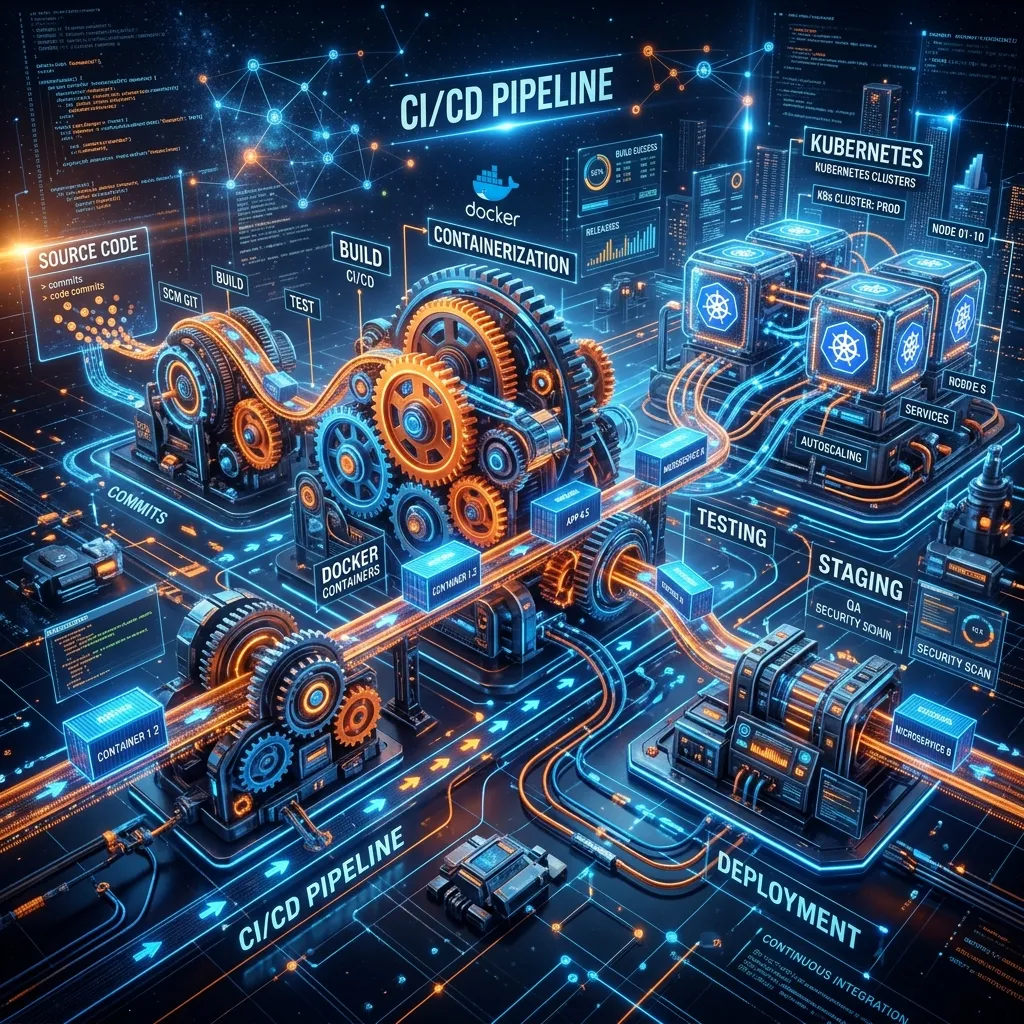
In the world of software development, the balance between speed and reliability is every engineering team’s biggest challenge. As IPEC Labs, we share the DevOps experiences we have gained while managing production-level platforms such as NZeca AI, NŞEFİM and Smart School Ecosystem in this comprehensive guide.
What is DevOps and Why is it Critical in 2026?
DevOps is a cultural and technical approach that breaks down the walls between software development and IT operations. In 2026, DevOps is no longer a “choice” but a mandatory discipline to compete. Customer expectations are rising rapidly: uninterrupted service, instant updates and zero-tolerance security standards are now the norm.
IPEC Labs’ DevOps philosophy is built on three core principles. First, every change must go through the automated pipeline, to minimize human error. Second, infrastructure must be defined as code (Infrastructure as Code). Third, monitoring and alerting systems must be proactive, problems must be detected by the team before the customer.
Our CI/CD Pipeline Architecture
IPEC Labs’ CI/CD pipeline is built on GitHub Actions and offers a fully automated process from every commit to production deployment. Our pipeline consists of five critical stages.
Stage 1: Code Quality Check
The first phase, which runs automatically on every push, ensures code quality. JavaScript/TypeScript linting is done with ESLint, code formatting consistency is checked with Prettier, and type safety is checked with TypeScript strict mode. If an error is detected at this stage, the pipeline stops and the developer is notified.
Phase 2: Automated Test Suite
Unit tests, integration tests and end-to-end tests are run at this stage. Order flow, payment integration and WebSocket connection tests are especially critical for the NŞEFİM platform. Our test coverage rate is determined as minimum 80%. PRs that fall below this threshold are automatically rejected.
Phase 3: Docker Image Build
All our projects run inside Docker containers. We minimize the production image size by using multi-stage build. For example, NŞEFİM’s production image is only 87MB in size, 60% smaller than traditional Node.js deployments.
Phase 4: Staging Deployment
Every change merged into the main branch is automatically deployed to the staging environment. Staging is an exact copy of production, same database schema, same environment variables, same infrastructure configuration. In this way, the “it was working on my computer” problem is completely eliminated.
Phase 5: Production Deployment
Production deployment is triggered when the git tag is created. Zero-interruption migration is ensured by using a blue-green deployment strategy. If the new version does not pass the health checks, automatic rollback is activated.
Google Cloud Run: Serverless Container Platform
All IPEC Labs production workloads run on Google Cloud Run. The biggest advantage of Cloud Run is that it consumes resources only when used and offers automatic scaling.
The advantages of Cloud Run for our NŞEFİM platform are remarkable. It instantly responds to traffic increases thanks to automatic scaling during peak hours (lunch and dinner). During night hours, the number of instances is minimized and the cost is optimized. In this way, our monthly infrastructure cost is 60% lower compared to fixed server models.
Cloud Run’s minimum instance feature also solves the cold start problem. We prevent interruptions in the user experience by keeping a minimum of 1 instance of our NZeca AI API always hot.
Our Containerization Strategy
Docker is the cornerstone of modern software deployment. IPEC Labs’ containerization strategy is based on several important principles.
Each service runs in its own container. NŞEFİM’s API service, WebSocket service and worker service are deployed as separate containers. In this way, each service can be scaled independently. When order density increases, simply scaling the WebSocket service is sufficient.
Using multi-stage build dramatically reduces image sizes. In the first stage, dependencies are installed and the application is compiled, and in the second stage, only the executable files are copied onto a lightweight base image.
Security scanning works automatically in every build. Known vulnerabilities are scanned with Trivy and the build is automatically stopped when a critical level vulnerability is detected.
Monitoring and Warning System
“Flying with your eyes closed” is unacceptable in a production environment. IPEC Labs’ monitoring infrastructure consists of three layers.
The first layer is application metrics: response times, error rates, throughput and number of active users are monitored in real time. The second layer is infrastructure metrics: CPU usage, memory consumption, disk I/O and network traffic are tracked. The third layer is business metrics: Business-oriented metrics are tracked, such as the number of orders per hour for NŞEFIM, and the daily query volume for NZeca.
Alert thresholds are set intelligently. Sounding the alarm at every small fluctuation causes the team to fall into alarm fatigue. Therefore, the alert is triggered only for situations that actually require intervention. For example, an alert is sent if the error rate remains above 5% for 5 minutes or the average response time exceeds 2 seconds.
Database Management and Migration
Database changes are one of the riskiest parts of software deployment. IPEC Labs’ migration strategy is designed to minimize this risk.
Every migration must be backward-compatible. A new column can be added, but an existing column cannot be deleted, at least not right away. The column deletion process is two-step: first the application code is updated, then the column is removed in the next release. This approach prevents data loss in case of rollback.
PostgreSQL’s JSONB columns are actively used for flexible data modeling. NŞEFİM’s platform integrations (Yemeksepeti, Getir, Trendyol) each send different data structures, JSONB elegantly absorbs these differences.
Secrets Management
Secure management of sensitive information (API keys, database passwords, OAuth client secrets) is critical. At IPEC Labs, no secrets are stored in the codebase or Docker image.
Google Cloud Secret Manager is the central repository for all our production secrets. Secret rotation occurs automatically, database passwords are automatically renewed every 90 days, API keys are automatically renewed every 180 days. Access control is managed with IAM policies and every access is logged.
Conclusion and Recommendations
DevOps is a culture, not a toolset. Choosing the right tools is important, but what is more important is that the team adopts these tools and internalizes the culture of continuous improvement.
As the IPEC Labs engineering team, we live and develop this culture every day. From NZeca AI to NŞEFİM, from Smart School to enterprise web projects, all our products run safely on this solid DevOps infrastructure.
The key to success in modern software development is as much in the quality of the process of bringing it to production as the quality of the code. DevOps is the guarantee of this process.
Subscribe to our newsletter!